

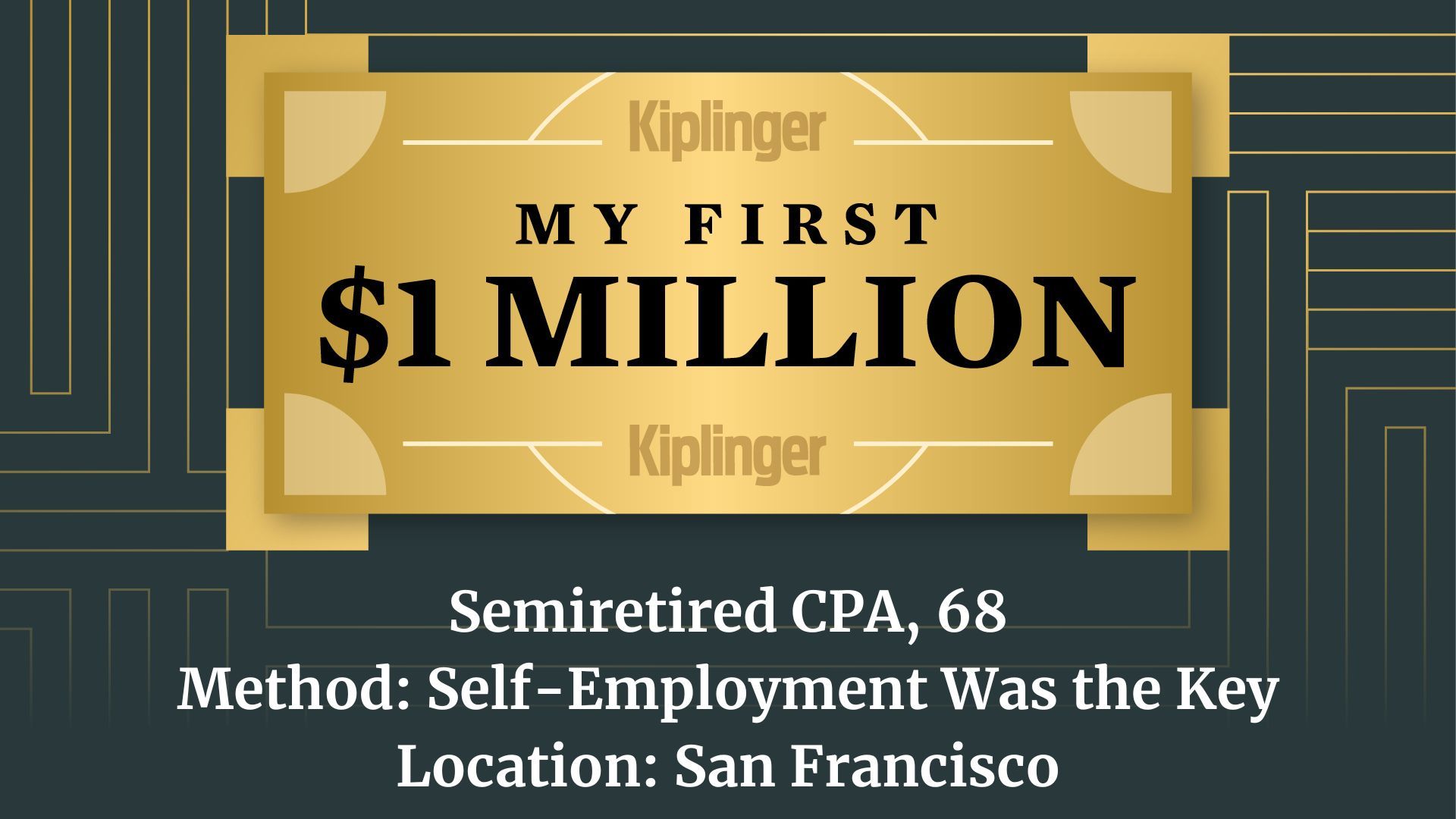

Welcome to Kiplinger’s My First $1 Million series, in which we hear from people who have made $1 million. They’re sharing how they did it and what they’re doing with it.
This time, we hear from a single 68-year-old semiretired certified public accountant in San Francisco. He owns his own firm, which had a staff of three to seven and 1,200 clients before he semiretired to work with “35 people I love to work for.”
See our earlier profiles, including a writer in New England, a literacy interventionist in Colorado, a semiretired entrepreneur in Nashville and an events industry CEO in Northern New Jersey. (See all of the profiles here.)
Sign up for Kiplinger’s Free Newsletters
Profit and prosper with the best of expert advice on investing, taxes, retirement, personal finance and more – straight to your e-mail.
Profit and prosper with the best of expert advice – straight to your e-mail.
Each profile features one person or couple, who will always be completely anonymous to readers, answering questions to help our readers learn from their experience.
These features are intended to provide a window into how different people build their savings — they’re not intended to provide financial advice.
THE BASICS
How did you make your first $1 million?
Gradual enrichment over time. Self-employment was the key. The cash flow allowed me to support multiple pieces of real estate (owning two homes, buying rentals), invest small amounts in the stock market and fund retirement accounts.

(Image credit: Getty Images)
The business kept growing, and the cash flows kept growing.
Two decades ago, I said to my father, “I am a millionaire.” His comment: “Isn’t everybody?”
From my experience, I knew this not to be true. When he passed, he left us each a few hundred thousand. There were many siblings. This made my third million even easier to achieve.
What are you doing with the money?
My career was successful, and I was confident that the cash flows were going to remain at a certain level throughout my career, so that let me explore opportunities.
I did not even realize (I’d made $1 million) until well on the way to the second million. The client/friend base for contacts and information was really the key to everything. I observed, asked questions, offered advice from my own knowledge and experiences.

(Image credit: Getty Images)
I knew how to get out of problem situations (2008 crash) or knew someone who could advise me when they happened.
I was more confident about the financial risks in everything. I understood the value of time and money. I showed others what I knew.
THE FUN STUFF
What is the best part of making $1 million?
Confidence.
Did your life change?
Not really.
Did you retire early?
LOOKING BACK
Anything you would do differently?
Honestly, I would have taken more risk earlier in my life.
What would you tell your younger self?
“Believe in yourself more!”
Did you work with a financial adviser?
I have had the same financial adviser since 1991. She has about $1.5 million of my funds. However, I do the taxation, which is just as important. I had a loss on the sale of a rental property around 2014, and it wiped out all of my income tax liability.
However, I had a good W-2, and my withholdings were set to cover all of the taxes.

(Image credit: Getty Images)
(My adviser) is Donna Andrews with Morgan Stanley, one of the strongest people I know and respect. When my confidence (has ebbed at times), she has walked me off many ledges.
Did anyone help you early on?
My last boss (whom I have no respect for) and his late wife taught me so much about people and money and being honest and who you are.
LOOKING AHEAD
Plans for your next million?
Already happened three or four times, and it will happen more by always being able to live within my means. This is assured.
Any advice for others trying to make their first $1 million?
Be patient — it does not have to happen overnight. You can make mistakes, especially at a young age, and recover. Have a plan B, if you can.

(Image credit: Getty Images)
Your passion will make it happen! Do not say, “I cannot do this.” Always be in the affirmative. Risk is always there. But so is reward.
Do you have an estate plan?
I have seen everything from suicide to dying of old age and how it affects those whom you know. The estate planning I have done is the most responsible in this regard. Don’t foist your problems on others that you love, if at all possible. If you are gone, others have to clean up your mess. Keep all of this up to date.
What do you wish you’d known …
Before you retired? I should have stopped working earlier, and if I had taken more wages instead of profits, my Social Security benefits would be greater. Still, they are $3,500 a month.
When you first started saving? That small amounts, consistently done over time, will grow. Cash has to be saved, but time will conquer all.

(Image credit: Getty Images)
I cashed out (on my business’ profits) early and often. If I hadn’t cashed out, I would be worth twice what I am today. However, I would not have had as much fun.
When you first started investing? I was stupid about credit when I was young. I did cash out a couple of times to pay credit card debt. Back then, I could deduct the unsecured interest on my taxes. When that ended, I had to pay things off quickly.
When you first started working with a financial professional? I know taxes, but I don’t know much about investing, and we talked and worked together. Working together has been the best.
Anything you’d like to add?
This is really what says everything about me: When my profession became work, it was no longer fun.
At 12, I saw my father (who I realized later on in life was a financial genius, but very conservative) working on the taxes for a relative. I asked a lot of questions that day and was amazed at the answers he provided.
As a bookworm, that set me off. I knew that I wanted to do taxes later on as my career. I realized that becoming a CPA was it. My family has a work ethic that was and still is amazing. I never planned on working for myself, and I am so grateful that I fell into that position.
A high school buddy got me a union job at a major grocery store chain in 1975. Pay was $50 an hour when the holiday was on a Sunday, overtime, benefits, everything. I went into major debt, living a lifestyle.
My college education was 14 years long. One class a quarter, always.
I bought a condo while working at a grocery store. That union job even provides me with a current pension — $500 a month — forever.

(Image credit: Getty Images)
A friend and I partnered on a home purchase. I went on cruises, bought sports cars, etc. But I always took that one class a quarter.
When I finally was able to say I had graduated (and had paid off my “fun” debt), I started looking for an accounting firm to work for. A résumé did not do it — I looked bad on paper, grades not the best, and I’d never done an office job in my life.
But I knew life, I was 30, and when I took the CPA exam the first time, I met some people. (When they talked to me, they saw my passion) come out, maybe not the ability, but the honest want of wanting to do more. No education debt, however. The work ethic shone through.
My first job at a firm: I lasted six months, and I bet they are still discovering my mistakes. At my second firm, I stayed with one partner 12 years and absorbed. I went from $45,000 at a grocery store to $17,000 in an accounting job at the beginning.
I bought another home in the very early ’90s. No money down.
Being around financially savvy people, who understood risk, and being in the heart and soul of Silicon Valley as it erupted took care of the rest. Time and place were on my side. Being a gay, respected source for information and solutions, in San Francisco, was the ticket.

(Image credit: Getty Images)
Me, using what I was showing other people to use, was the proof to people.
Being honest and transparent showed my belief in myself and to others what they could accomplish with their own thoughts, ideas and life.
This was fun. People thanked me. I always asked the clients to thank my staff, because without a great support system, I would have been nothing. If we made money in the firm, they were always benefiting. Bonuses were huge, benefits were paid for, time off was easy to get.
Life happens — accept it and show others how to navigate through theirs.
If you have made $1 million or more and would like to be anonymously featured in a future My First $1 Million profile, please fill out and submit this Google Form or send an email to MyFirstMillion@futurenet.com to receive the questions. We welcome all stories that add up to $1 million or more in your accounts, although we will use discretion in which stories we choose to publish, to ensure we share a diversity of experiences. We also might want to verify that you really do have $1 million. Your answers may be edited for clarity.
RELATED CONTENT
TOPICS
