
Close Menu
    Facebook X (Twitter) Instagram
    GramsaveGramsave
    • Income and Side Hustles
    • Money Psychology and Habits
    • Financial Planning and Goals
    • Credit and Credit Scores
    • Investment and Wealth Building
    Facebook X (Twitter) Instagram
    GramsaveGramsave
    Financial Planning and Goals

    Corporate taxes in 2026: State differences advisors should know

    awais.host01By awais.host01January 14, 2026No Comments3 Mins Read
    Corporate taxes in 2026: State differences advisors should know

    Corporate tax policy doesn’t usually drive day-to-day portfolio decisions. But for business-owning clients, it can meaningfully shape everything from entity choice to where future growth makes the most sense.

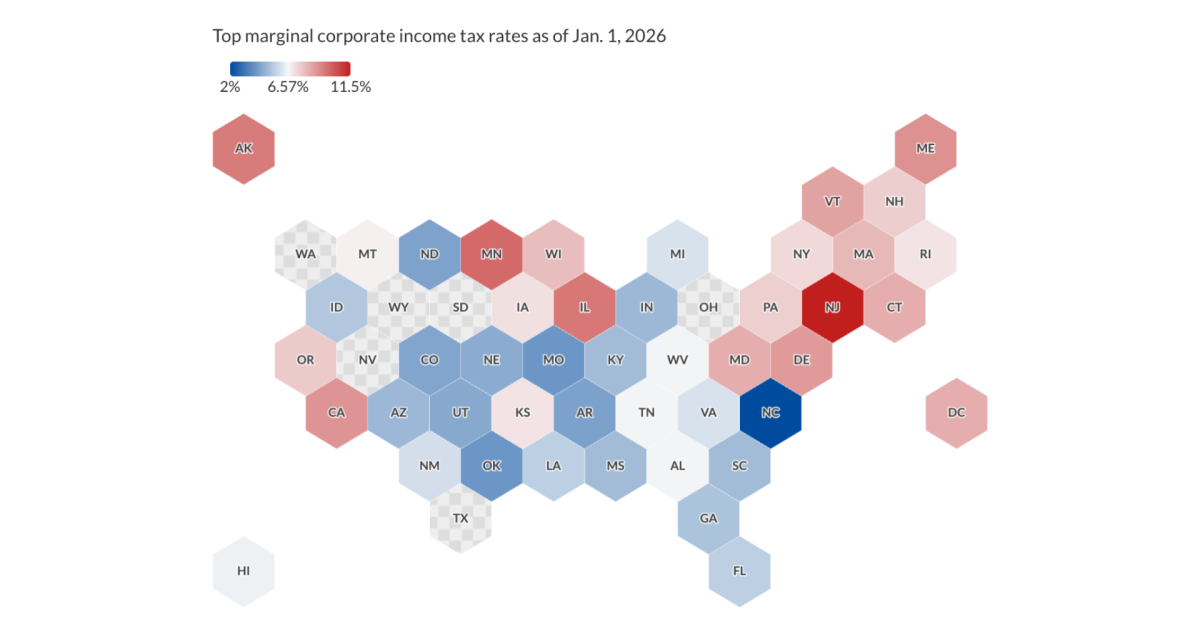
    As of 2026, 44 states and Washington, D.C. impose a corporate income tax, with top marginal rates ranging from 2% in North Carolina to 11.5% in New Jersey. Among states with a corporate tax, the average top rate is about 6.6%. However, this figure masks wide differences in how heavily states tax business profits and how stable those tax systems are over time.

    map visualization

    For clients considering relocation or expansion, these differences can have real planning implications. Higher rates or more complex tax structures can add friction for businesses, particularly when surtaxes, gross receipts taxes or local-level levies are involved.

    To avoid those considerations in the first place, most business owners operate as pass-through entities — S corporations, sole proprietorships or partnerships — while a select few run C corps, which tend to be larger businesses, according to Luke Neumann, director and wealth manager at Boston-based Crestwood Advisors.

    While state-level corporate taxes can be impactful, Neumann said that C corp founders and owners tend to base location decisions more on access to talent, regulatory environment and overall business friendliness. Many also prioritize the qualified small business stock (QSBS) capital gains exemption, uniquely available to C corps.

    “They are less concerned around double taxation (i.e., taxation at the entity level then at the personal level) since the C corps are likely loss-making for the first few (or many) years while the business grows,” Neumann said in an email.

    But corporate income taxes aren’t the only consideration. In their place, some states impose gross receipts taxes — levied on total sales or revenue without deductions for expenses such as cost of goods sold, labor or other operating costs — which economists generally view as especially harmful.

    Nevada, Ohio, Texas and Washington rely on gross receipts taxes in place of traditional corporate income taxes. Delaware, Oregon and Tennessee levy gross receipts taxes alongside corporate income taxes, while certain localities in Pennsylvania, Virginia and West Virginia impose local gross receipts taxes even though the states themselves do not.

    Several states made notable changes this year. Nebraska, North Carolina and Pennsylvania all reduced corporate income tax rates, continuing a longer-term trend toward gradual rate compression. Meanwhile, a small group of high-tax states remain outliers, with top marginal rates near or above 9%, often paired with surtaxes that primarily affect large, profitable companies.

    slope visualization

    For clients launching a new business or relocating or expanding an existing one, the states below represent some of the most — and least — favorable corporate tax environments in 2026.

    Advisors Corporate differences state taxes
    awais.host01
    • Website

    Related Posts

    When Do W-2s Arrive in 2026? Deadlines, Trump Tax Changes, and What to Expect

    January 14, 2026

    Real Middle Class Wages as of December 2025

    January 14, 2026

    5 Things to Know About Edward Jones Credit Cards

    January 14, 2026
    Leave A Reply Cancel Reply

    Recent Posts
    • When Do W-2s Arrive in 2026? Deadlines, Trump Tax Changes, and What to Expect
    • Corporate taxes in 2026: State differences advisors should know
    • Real Middle Class Wages as of December 2025
    • 5 Things to Know About Edward Jones Credit Cards
    • Global EV sales growth likely to slow after 20% jump in rocky 2025, research firm says
    More About GramSave

    GramSave is a personal finance blog dedicated to helping readers better understand budgeting, saving, money habits, and modern financial tools. We publish simple, practical, and research-based articles designed to support smarter financial choices—no jargon, no pressure, just clear information.

    Most Popular
    • When Do W-2s Arrive in 2026? Deadlines, Trump Tax Changes, and What to Expect
    • Corporate taxes in 2026: State differences advisors should know
    • Real Middle Class Wages as of December 2025
    • 5 Things to Know About Edward Jones Credit Cards
    • Global EV sales growth likely to slow after 20% jump in rocky 2025, research firm says
    Our Picks
    • When Do W-2s Arrive in 2026? Deadlines, Trump Tax Changes, and What to Expect
    • Corporate taxes in 2026: State differences advisors should know
    • Real Middle Class Wages as of December 2025
    • 5 Things to Know About Edward Jones Credit Cards
    • Global EV sales growth likely to slow after 20% jump in rocky 2025, research firm says
    Categories
    • Budgeting Basics and Methods
    • Credit and Credit Scores
    • Debt Management and Payoff
    • Financial Planning and Goals
    • Income and Side Hustles
    • Investment and Wealth Building
    • Money Psychology and Habits
    • Saving Money and Emergency Funds
    • Tools and Technology
    Facebook X (Twitter) Instagram Pinterest
    • Home
    • About Us
    • Contact Us
    • Terms and Conditions
    • Privacy Policy
    © 2026 GramSave. Designed by GramSave.

    Type above and press Enter to search. Press Esc to cancel.