
Close Menu
    Facebook X (Twitter) Instagram
    GramsaveGramsave
    • Income and Side Hustles
    • Money Psychology and Habits
    • Financial Planning and Goals
    • Credit and Credit Scores
    • Investment and Wealth Building
    Facebook X (Twitter) Instagram
    GramsaveGramsave
    Financial Planning and Goals

    ABLE eligibility expands in 2026 for clients with disabilities

    awais.host01By awais.host01January 3, 2026No Comments5 Mins Read
    ABLE eligibility expands in 2026 for clients with disabilities

    The start of 2026 offers a significant opportunity for financial advisors who serve clients with family members that have special needs.

    Processing Content

    Before now, Achieving a Better Life Experience (ABLE) savings accounts were only available to individuals with significant disabilities before age 26. Now, the starting age limit has risen to 46.

    Created in 2014 as tax-advantaged savings accounts for those with disabilities, ABLE accounts secure funds for disability-related expenses that public services do not cover.

    The change has great significance for Evan H. Farr, principal attorney at Farr Law Firm in Fairfax, Virginia, who offers estate planning and elder law services for families, and adults and children with disabilities, many of whom currently use ABLE accounts.

    Attorneys and financial advisors should begin preparing now for this change by looking for potential clients with disabled family members whose disabilities began between the ages of 26 and 45, said Farr. This will be especially significant for older adult children with disabilities, traumatic brain injuries and late-onset disabilities, he said.

    “This will be a boon for families of children with mental illness, which often doesn’t manifest until their mid to late 20s,” he said.

    READ MORE: How financial advisors can buy a wealth book of business

    Patricia Roberts, chief operating officer at Gift of College, is a financial educator on ABLE accounts. The issue is a personal one for her as her brother, Norman, has a developmental disability. She said he has benefited greatly from opening an ABLE account, as disabled clients often are in danger of losing public benefits if they save too much money outside of an ABLE account.

    “The creation of ABLE accounts brought long-overdue financial independence to my brother — and welcomed peace of mind to me,” she said.

    Experts say ABLE accounts offer many benefits, but that they should be used carefully in conjunction with other methods to ensure there are no unintended consequences.

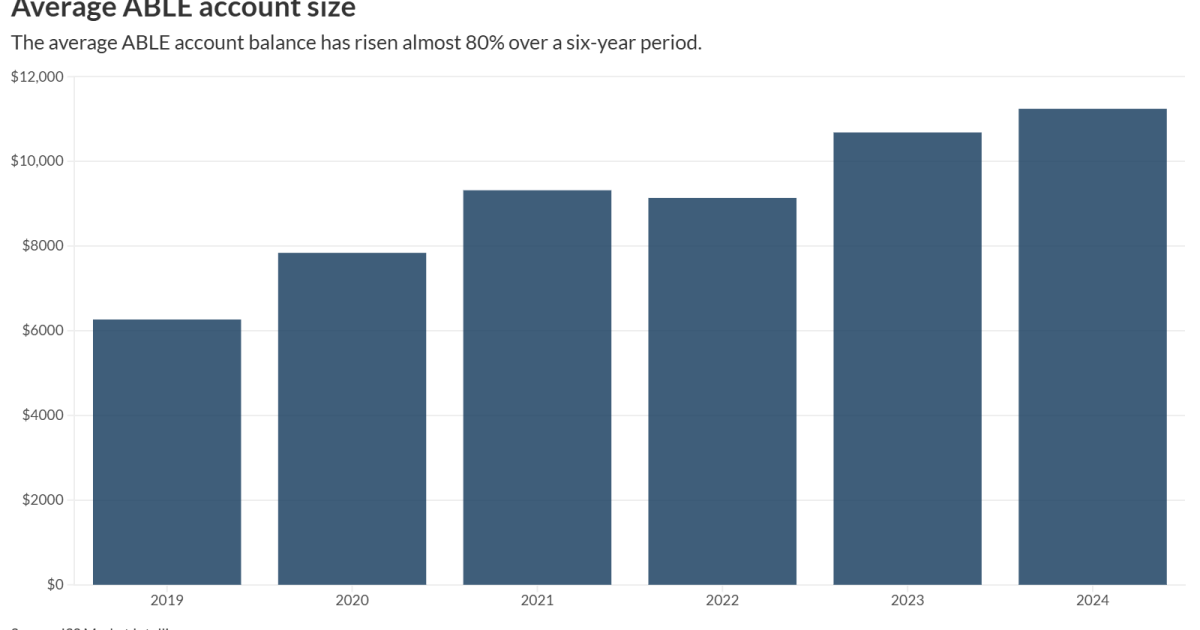
    chart visualization

    What an ABLE account offers

    Mindy Neira, a wealth manager and principal at Modera Wealth in Cedar Grove, New Jersey, is a chartered special needs consultant who has clients with family members who use ABLE accounts. Before entering her current profession, she was an in-home therapist for children with autism and their families for three years.

    ABLE accounts offer checking account features, tax-deferred growth with tax-free withdrawals for qualified disability expenses, and resource protection up to certain limits for SSI, Medicaid and other community programs, said Neira.

    Clients with disabilities often have expenses that go beyond what advisors would see in a typical financial plan, she said. This can include support for daily living, job assistance, assistive technology, medical costs that are not covered and even home or vehicle modifications.

    “Some of these are big one-time expenses while others are ongoing, lasting for their lifetime,” she said.

    READ MORE: Advisors clamor for estate planning tools as attorneys wave red flags

    Whether it’s young children of clients with disabilities or an adult who was in an accident and has sustained injuries, these costs change over time, said Neira. Planning for these evolving needs helps advisors choose the right mix of account types such as ABLE accounts, special needs trusts and 529 plans, she said.

    “In many financial plans, it is common to see a combination of account types used,” she said. “I think about this similarly to how we broadly use various account types such as brokerage investment accounts, Roth IRAs and traditional IRAs. Each has a place in the plan.”

    Combining ABLE accounts with special needs trusts

    Another point to consider is whether there are loved ones who want to gift or leave an inheritance to a client with a disability. How this money is left to the individual can mean the difference between maintaining or losing benefits.

    Advisors serving clients with disabilities must implement a communication strategy to educate the client’s broader network of family and friends on the risks of direct gifting.

    In his special needs financial planning practice, Michael Davis, a financial planner with Legs Financial in Greensboro, North Carolina, said he helps families navigate “the two-lifetime funding puzzle.”

    “Many parents face the daunting task of funding both their own retirement and a potential 60-year lifespan for a loved one with special needs,” he said.

    For example, an unintended inheritance can trigger a disqualification from means-tested benefits, such as SSI and Medicaid, which require strict adherence to a $2,000 asset limit, or $3,000 if they are married.

    “A key component of this strategy is a rigorous estate plan review to ensure assets are never left directly to the individual,” said Davis.

    ABLE accounts are particularly helpful when used in conjunction with special needs trusts, as the ABLE account distributions may be used to pay for ordinary living expenses — food and housing — without jeopardizing SSI or Medicaid eligibility, said Farr.

    Even with this change, ABLE accounts are still not substitutes for these trusts, he said. ABLE accounts require Medicaid payback to the state, whereas third-party special needs trusts don’t.

    “However, ABLE accounts will become a much more valuable supplement for many families with the expanded age eligibility,” he said.

    Clients disabilities eligibility expands
    awais.host01
    • Website

    Related Posts

    Stocks Struggle for Gains to Start 2026: Stock Market Today

    January 3, 2026

    S&P 500 Snapshot: Index Posts 16.4% Gain in 2025

    January 2, 2026

    HNW Retirees: Don’t Overlook The Benefits of Social Security

    January 2, 2026
    Leave A Reply Cancel Reply

    Recent Posts
    • Stocks Struggle for Gains to Start 2026: Stock Market Today
    • ABLE eligibility expands in 2026 for clients with disabilities
    • S&P 500 Snapshot: Index Posts 16.4% Gain in 2025
    • HNW Retirees: Don’t Overlook The Benefits of Social Security
    • Swiss resort fire likely started by sparkler candles, many of the injured fighting for their lives
    More About GramSave

    GramSave is a personal finance blog dedicated to helping readers better understand budgeting, saving, money habits, and modern financial tools. We publish simple, practical, and research-based articles designed to support smarter financial choices—no jargon, no pressure, just clear information.

    Most Popular
    • Stocks Struggle for Gains to Start 2026: Stock Market Today
    • ABLE eligibility expands in 2026 for clients with disabilities
    • S&P 500 Snapshot: Index Posts 16.4% Gain in 2025
    • HNW Retirees: Don’t Overlook The Benefits of Social Security
    • Swiss resort fire likely started by sparkler candles, many of the injured fighting for their lives
    Our Picks
    • Stocks Struggle for Gains to Start 2026: Stock Market Today
    • ABLE eligibility expands in 2026 for clients with disabilities
    • S&P 500 Snapshot: Index Posts 16.4% Gain in 2025
    • HNW Retirees: Don’t Overlook The Benefits of Social Security
    • Swiss resort fire likely started by sparkler candles, many of the injured fighting for their lives
    Categories
    • Budgeting Basics and Methods
    • Credit and Credit Scores
    • Debt Management and Payoff
    • Financial Planning and Goals
    • Income and Side Hustles
    • Investment and Wealth Building
    • Money Psychology and Habits
    • Saving Money and Emergency Funds
    • Tools and Technology
    Facebook X (Twitter) Instagram Pinterest
    • Home
    • About Us
    • Contact Us
    • Terms and Conditions
    • Privacy Policy
    © 2026 GramSave. Designed by GramSave.

    Type above and press Enter to search. Press Esc to cancel.