

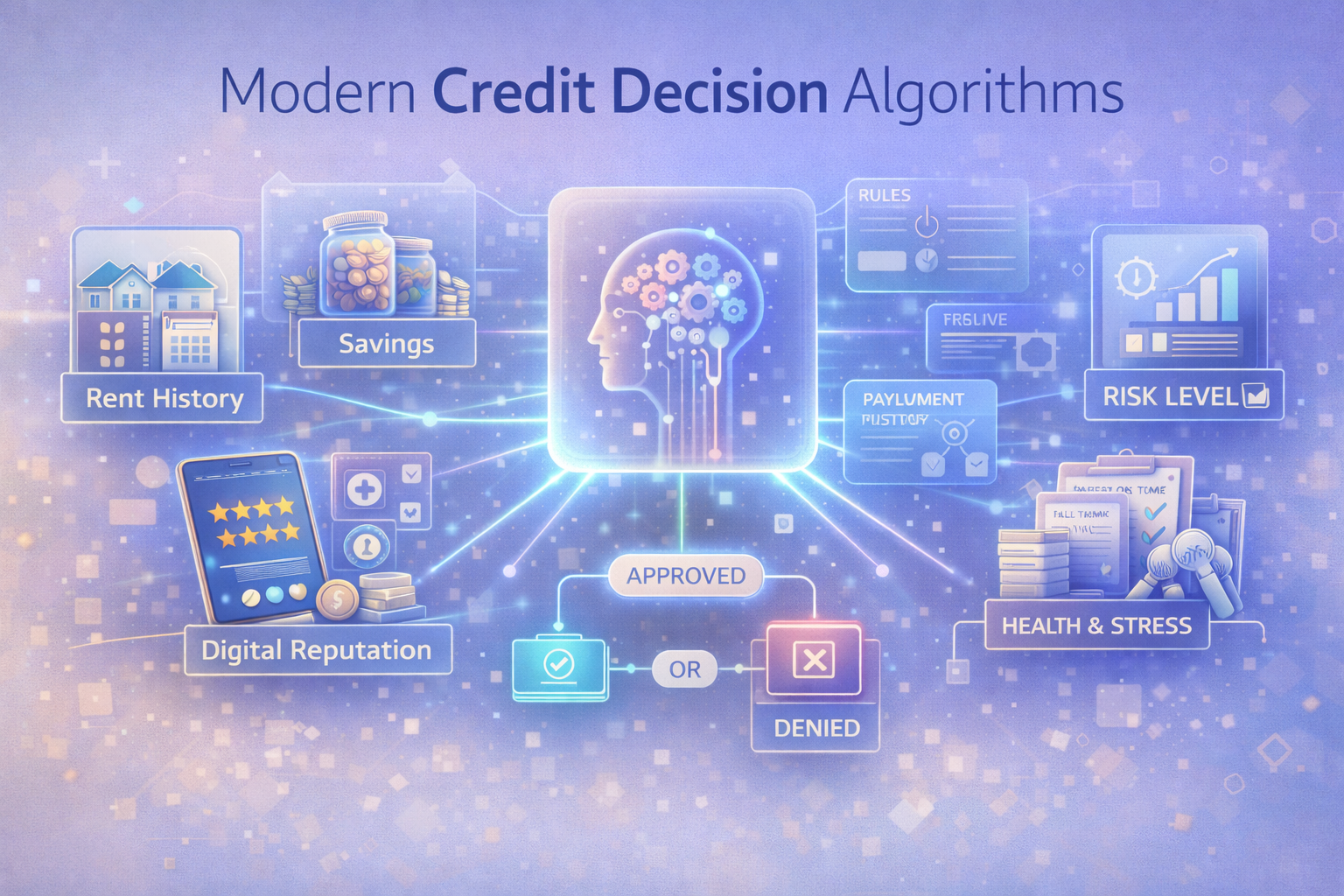
You’ve checked your credit score and feel confident about your financial standing, but the loan denial letter says otherwise. Or maybe you were approved, but the interest rate is significantly higher than what friends with similar incomes are paying. The disconnect isn’t random—modern credit decision algorithms rely on precise mathematical formulas and automated systems that process your credit report data with mechanical accuracy. When these systems encounter even minor inaccuracies on your report, they don’t pause to consider context or give you the benefit of the doubt. They simply calculate risk based on what they see.
What most people don’t realize is that a single reporting error can trigger consequences far beyond what seems reasonable. An incorrectly reported balance might push you into a different risk tier, costing thousands in additional interest. A payment marked late by mistake could drop your score enough to turn an approval into a denial. Understanding how modern credit decision algorithms work—and more importantly, how to identify and correct the errors feeding into them—gives you the power to ensure your credit profile accurately reflects your true financial responsibility. The math doesn’t lie, but it can only work with the data it receives.
How Credit Scoring Algorithms Transform Your Report Into a Number
The mathematical foundation of credit scoring operates on a weighted hierarchy that assigns specific percentages to five core categories of your credit behavior. Payment history commands 35% of your FICO score calculation, making it the single most influential factor in determining your three-digit number. Credit utilization follows at 30%, measuring how much of your available credit you’re actively using. Length of credit history accounts for 15%, while credit mix and new credit inquiries each contribute 10%. This distribution reflects decades of statistical analysis correlating specific financial behaviors with default probability—and it forms the backbone of modern credit decision algorithms used across lending systems today.

The weighted structure creates a critical vulnerability: errors in the highest-weighted categories inflict disproportionate damage. A single incorrectly reported late payment in your payment history can drop your score by 60 to 110 points, depending on your starting position and the recency of the alleged delinquency. Meanwhile, an error in a lower-weighted category—such as an incorrectly reported hard inquiry—might only suppress your score by 5 to 10 points. When modern credit decision algorithms process your application, they don’t evaluate whether a late payment might be inaccurate; they simply calculate risk based on the data present.
The distinction between FICO and VantageScore models adds another layer of complexity to how credit scores are calculated within modern credit decision algorithms. FICO 8, still the most widely used scoring model among mortgage lenders, treats paid collections as negative items that continue to impact your score for seven years. VantageScore 3.0 and 4.0, by contrast, ignore paid collections entirely. Medical debt is handled differently as well, meaning an incorrectly reported medical collection can severely damage outcomes produced by modern credit decision algorithms depending on which model a lender uses.
Every credit score comes with reason codes—specific explanations for why your score isn’t higher. These codes reveal which data points are suppressing your number most severely. A reason code stating “proportion of balances to credit limits too high” points directly to utilization problems, while “derogatory public record or collection filed” signals damage within payment history. These reason codes exist because modern credit decision algorithms must translate complex calculations into simplified explanations for lenders and regulators.
Credit scoring also functions as a relative measurement system, comparing your credit profile against millions of other consumers. Your score represents your position within a risk distribution curve, not an absolute judgment of financial responsibility. When an error shifts you from one percentile to another, modern credit decision algorithms may route your application into an entirely different risk tier with stricter approval criteria, higher interest rates, or outright denial. This is why correcting even small inaccuracies can produce outsized improvements—the math recalibrates your position within the broader credit landscape.
How Risk-Based Pricing Tiers Determine Your Interest Rate
Lenders structure their pricing using tiered brackets that translate credit scores into interest rates with mathematical precision. The typical mortgage lender establishes distinct pricing tiers: borrowers with scores of 740 or above qualify for the best available rates, those between 670 and 739 receive mid-tier pricing, and applicants below 670 enter subprime territory with significantly higher rates. These cutoffs are hardcoded into pricing engines powered by modern credit decision algorithms, which automatically assign your interest rate based on your score’s tier placement. A borrower with a 741 score might receive a 6.5% mortgage rate, while someone at 738 is quoted 6.875%, creating a cost difference of thousands of dollars over the loan’s lifetime despite only a three-point gap.
The dramatic cost implications of tier boundaries make credit report accuracy financially critical. On a $300,000 30-year mortgage, the difference between a 6.5% rate and a 6.875% rate amounts to roughly $24,480 over the loan term. If an incorrectly reported credit card balance inflates your utilization ratio and drops your score from 745 to 735, modern credit decision algorithms immediately reclassify you into a higher-cost pricing tier. The added expense reflects not your actual financial behavior, but the math reacting to inaccurate data.
These pricing shifts exist because modern credit decision algorithms are trained on historical default data that shows borrowers below certain thresholds default at measurably higher rates. Lenders don’t subjectively adjust these outcomes—they rely on statistically validated cutoffs embedded into automated pricing logic. Once your score falls below a tier boundary, the pricing adjustment happens instantly and without discretion.
Manual underwriting introduces the possibility of compensating factors—such as low debt-to-income ratios or significant cash reserves—that can override automated outcomes. However, this human review only works if your credit report accurately reflects your risk profile. When errors like duplicate accounts or misreported charge-offs appear, modern credit decision algorithms may already have routed your application into a higher-risk category before a human ever sees it, limiting the underwriter’s ability to adjust pricing favorably.
Different lenders apply their own tier thresholds based on risk appetite, creating opportunities for rate shopping. One lender may offer strong pricing at 680, while another requires 700 for the same rate. But this flexibility only exists when your data is clean. If reporting errors suppress your score below key thresholds, modern credit decision algorithms classify you as subprime across lenders, eliminating competitive pricing opportunities entirely.
Risk-based pricing compounds across your financial life. The same credit report error that raises your auto loan APR also affects credit card interest rates, refinancing options, and even insurance premiums in states that allow credit-based pricing. Because modern credit decision algorithms apply tier logic automatically and consistently, there is no rounding up, negotiation, or benefit of the doubt—only recalculation once the underlying data is corrected.
Why Automated Underwriting Systems Miss Your Full Story
The lending industry’s shift from human underwriters to algorithmic decisioning platforms has fundamentally changed how credit applications are evaluated. Systems like Desktop Underwriter, Fannie Mae’s automated mortgage engine, process hundreds of data points from your credit report, income documentation, and asset verification in seconds. Credit card issuers deploy proprietary models that instantly approve or deny applications based on bureau data, account history, and internal risk rules. These modern credit decision algorithms operate with speed and consistency humans can’t match—but they sacrifice context for efficiency. An algorithm cannot distinguish between a legitimate 30-day late payment caused by hardship and an identical entry caused by a reporting error; both receive the same risk weighting.

Automated systems flag specific data patterns as high-risk indicators, triggering denials or adverse pricing without human intervention. Duplicate accounts created by furnisher errors appear to modern credit decision algorithms as multiple debts, inflating debt-to-income ratios and utilization calculations. An account incorrectly marked “charge-off” instead of “paid as agreed” signals default risk even if it was resolved years ago. Disputed collections or judgments that remain on your report during investigations are treated as factual, because modern credit decision algorithms apply binary logic—the data either qualifies or it doesn’t.
Tradeline completeness plays a critical yet overlooked role in automated underwriting. When credit reports contain missing fields—such as unknown credit limits or gaps in monthly payment history—modern credit decision algorithms face uncertainty. Instead of assuming favorable intent, they default to conservative interpretations. A card without a reported limit can’t help utilization ratios, while its balance still counts against you. Inconsistent reporting timelines across tradelines create ambiguity that algorithms resolve by applying stricter risk rules.
The heightened importance of credit report accuracy in the automated underwriting era cannot be overstated. When humans reviewed applications, they could spot obvious inconsistencies—duplicate debts, late payments after account closure—and investigate further. Modern credit decision algorithms lack that intuition. They process data exactly as received from credit bureaus, applying mathematical formulas without questioning accuracy. This mechanical precision means errors now flow directly into approval and pricing decisions without a human quality-control checkpoint.
Most automated underwriting platforms include an exception queue where borderline applications may be reviewed manually. Whether you reach that stage depends heavily on how modern credit decision algorithms interpret your data. A clean, coherent credit report that narrowly misses automated approval is more likely to receive human review. But conflicting information, unexplained negatives, or distorted patterns increase the odds of an outright denial. In today’s lending environment, manual underwriting can only help if the data feeding the algorithm accurately reflects your true financial behavior.
Why Certain Credit Report Errors Cause More Damage Than Others
Payment history errors represent the most destructive category of credit report inaccuracies due to their dominant 35% weight in score calculations. A single incorrectly reported 30-day late payment can drop your score by 60 to 110 points, with the exact impact depending on your starting score and the recency of the alleged delinquency. Recent late payments inflict more damage than older ones—a late payment from last month might drop a 780 score to 670, while the same error from three years ago might only suppress a similar score to 720. The seven-year reporting period for late payments means an uncorrected error continues to damage your credit profile for years, affecting every credit application during that window. Correcting a payment history error doesn’t just restore lost points; it eliminates a red flag that triggers automatic denials in many automated underwriting systems.
Utilization miscalculations create immediate and severe score suppression because they affect the second-highest weighted category at 30% of your score. When a creditor incorrectly reports your balance—showing $4,500 used on a $5,000 credit limit instead of your actual $500 balance—the algorithm calculates a 90% utilization rate rather than the actual 10%. Credit scoring models penalize utilization above 30% progressively, with rates above 50% causing dramatic score drops. This type of error commonly occurs during billing cycle timing issues, where creditors report your statement balance rather than your current balance after you’ve made a payment. The mathematical impact is immediate: a utilization error can drop your score 50 to 100 points overnight, pushing you from prime to subprime territory and disqualifying you from favorable lending terms across all credit products.
Account status inaccuracies carry consequences that extend beyond score impact into automated underwriting decision logic. The difference between an account marked “charge-off” versus “paid as agreed” is categorical—the former triggers automatic denials in many lending algorithms regardless of your credit score. Charge-offs signal that a creditor has written off your debt as uncollectible, a designation that remains visible for seven years and creates a permanent red flag in your credit history. Even if you settled the debt and have documentation proving resolution, an account incorrectly maintained as “charge-off” rather than updated to “paid” or “settled” continues to generate denials. This error type demonstrates how credit report inaccuracies can create binary approval barriers that no amount of compensating factors can overcome in automated systems.
Duplicate accounts artificially inflate your apparent debt obligations through furnisher errors that report the same debt to multiple bureaus or list the same account under different names following corporate mergers or account sales. When a collection agency purchases your debt from the original creditor and both entities report the obligation separately, automated underwriting systems count it twice in debt-to-income calculations. A $5,000 debt incorrectly appearing as two separate $5,000 obligations makes you appear to carry $10,000 in debt, dramatically worsening your debt-to-income ratio and utilization metrics. These duplicate entries are particularly insidious because they’re not immediately obvious when reviewing your credit report—you must cross-reference account numbers, dates, and original creditors to identify that multiple entries represent the same underlying obligation.
Inquiry inflation from unauthorized hard inquiries accumulates through identity theft or lender errors, creating a pattern that algorithms interpret as credit-seeking behavior. While a single hard inquiry typically suppresses scores by only 5 to 10 points, multiple inquiries within a short period signal financial distress or fraud risk to automated systems. The impact extends beyond score suppression: fraud detection algorithms flag accounts with unusual inquiry patterns for additional verification or automatic denial. If you discover five unauthorized inquiries on your report from lenders you never contacted, you’re dealing with a 25 to 50 point score drop and triggering security protocols that can freeze your credit applications until the inquiries are investigated and removed. The inquiry category demonstrates how even lower-weighted scoring factors create operational barriers in automated underwriting when errors accumulate.
How to Audit, Dispute, and Rebuild Your Credit With Precision
The forensic audit approach to credit report review is essential in an era dominated by modern credit decision algorithms. It requires obtaining reports from all three bureaus—Equifax, Experian, and TransUnion—and conducting a systematic comparison to identify discrepancies. Each bureau maintains independent databases and receives information from creditors at different times, creating opportunities for inconsistencies. An account might appear on Experian but not Equifax, or show different payment histories across bureaus due to furnisher reporting variations. Your audit should cross-reference each tradeline against your own financial records: bank statements, payment receipts, settlement letters, and account statements. This documentation serves dual purposes—it helps you identify inaccuracies and ensures the data feeding modern credit decision algorithms reflects reality rather than reporting noise.
Strategic dispute filing under the Fair Credit Reporting Act activates your legal right to accurate credit reporting and directly challenges the inputs used by modern credit decision algorithms. Dispute letters should identify each specific inaccuracy, explain why the information is incorrect, and include concrete supporting documentation. Effective disputes avoid vague claims and instead provide proof, such as bank statements or creditor correspondence showing on-time payment. The FCRA requires credit bureaus to investigate disputes within 30 days and either verify or remove the information, turning credit accuracy into a regulatory obligation rather than a discretionary review process.
Escalation tactics become critical when bureaus verify incorrect information without adequate investigation. Filing complaints with the Consumer Financial Protection Bureau creates regulatory pressure and often results in deeper review. Requesting the bureau’s method of verification—how the information was confirmed and by whom—can expose procedural failures. Contacting furnishers directly is often more efficient, since they control the source data and can update all three bureaus simultaneously. Correcting data at the source prevents repeated contamination of modern credit decision algorithms across future applications.
Building positive credit signals while disputes are pending ensures your profile continues to strengthen even before errors are removed. Strategic utilization management—keeping balances below 10%—maximizes scoring impact. Authorized user accounts with long, perfect histories add positive depth, while avoiding new inquiries preserves score stability. These actions ensure that once inaccuracies are corrected, the recalculated outputs from automated systems accurately reflect your true financial behavior rather than legacy errors. Timing your credit applications strategically maximizes the benefit of successful dispute resolutions.
The Mathematics of Your Financial Future
The disconnect between your financial reality and your credit score often traces back to a simple truth: modern credit decision algorithms don’t evaluate context—they calculate risk based solely on the data they receive. When that data contains errors—whether it’s an incorrectly reported balance, a duplicate account, or a payment marked late by mistake—the mathematical formulas driving lending outcomes work against you with mechanical precision. These aren’t minor inconveniences; they’re concrete financial penalties that can cost thousands in higher interest rates and lost approval opportunities.

Understanding how modern credit decision algorithms weight different factors, how risk-based pricing tiers translate scores into rates, and which types of errors inflict the most damage transforms credit management from guesswork into strategic action. Your credit report isn’t just a financial report card—it’s the raw input powering every automated lending decision made about you.
When you ensure that data accurately reflects your true financial behavior, you’re not gaming the system—you’re correcting the inputs that modern credit decision algorithms rely on to determine your creditworthiness. The math itself isn’t unfair, but it can only be as accurate as the information it’s fed.
